The third and last phase of the High Line opened to the public yesterday, so today I walked the full length of it, from 34th Street on the north to Gansevoort Street on the south. On my visit I decided to try out a timelapse app on my smartphone, and while the results are very amateurish (particularly the 5-degree tilt from horizontal that predominates, not to mention the occasional blurry shots and a close-up of my fingers at one point) the 2:46 clip does give a good idea of the changing character of the park and its context.
Want a soundtrack for the walk? I'd recommend a 3-minute chunk of Yo La Tengo's Autumn Sweater, as remixed by Kevin Shields. The song is embedded below and set to play the recommended part. Just press play on the song right after you press play on the timelapse and enjoy.
Any other songs or pieces of music ideal for a walking the High Line? Please comment with suggestions.
Monday, September 22, 2014

Weekend finds


Sunday, September 21, 2014
Architecture + Urbanism recommends 'Sinister Dialogues'
SINISTER DIALOGUES
A collective symposium on the negotation of sinister uses through building reuse
Thursday 25 September 2014 10am - 5pm Manchester School of Art
This day long symposium will focus on reusing existing buildings, memory and architecture and includes talks from Irish architect Sheila O'Donnell who worked on the Good Shepherd Laundry and Letterfrack Furniture College, German architect HG Merz who transformed the Sachsenhausen Concentration Camp in Berlin, architecture academic Margherita Vanore from Venice School of Architecture who writes about Industrial Ruins, interior design academic Terry Meade who writes about violence and domestic space in Palestine, artist Abigail Reynolds who created a series of artworks for the Topophobia Exhibition in Liverpool and Principal Lecturer Sally Stone from Manchester School of Architecture author of Re:Readings who writes about building reuse.
Document? Monument?
HG Merz (HG Merz Architekten Museumsgestalter)
Folds in Time
Abigail Reynolds (Artist)
Strangers in the House
Terry Meade (Brighton School of Architecture)
Landmarks of Memory
Sally Stone (Manchester School of Architecture)
Tracing Ruins in Producing Landscapes
Margherita Vanore (IUAV Universita di Venezia)
Addition and Subtraction
Sheila O'Donnell (O'Donnell + Tuomey Architects)
Organised by Laura Sanderson the event is free of charge and includes refreshments throughout the day.
Today's archidose #783
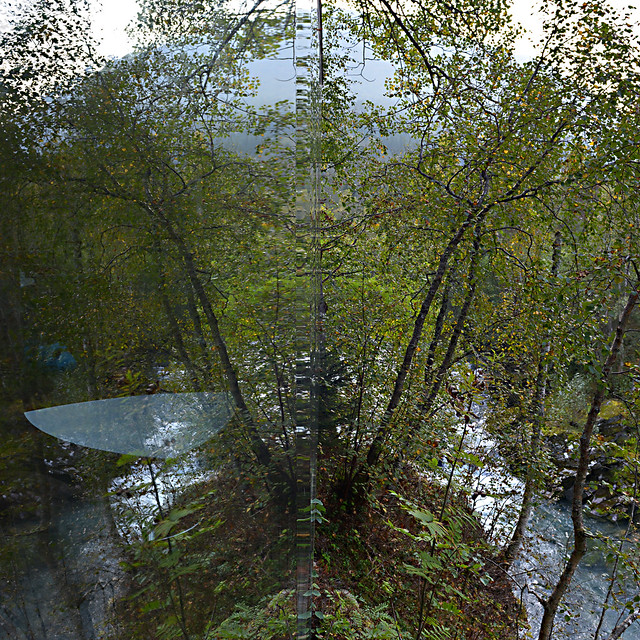
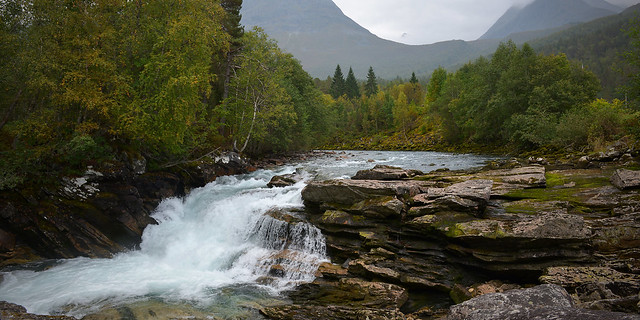
Here are some photos of the Juvet Landscape Hotel (2009, with 2013 addition) in Norddal, Norway, by Jensen & Skodvin, photographed by Flemming Ibsen.
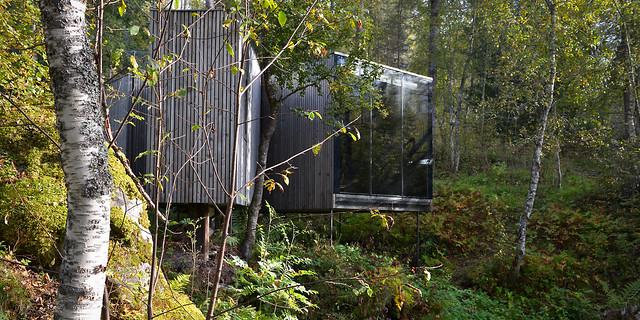
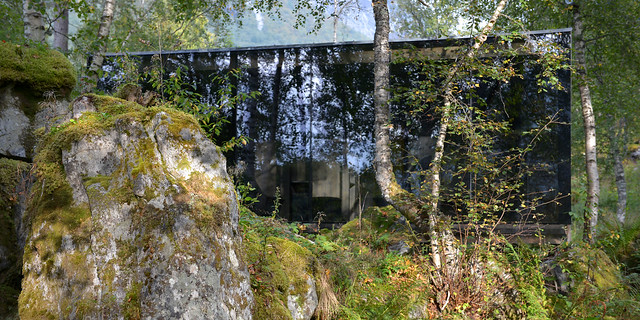
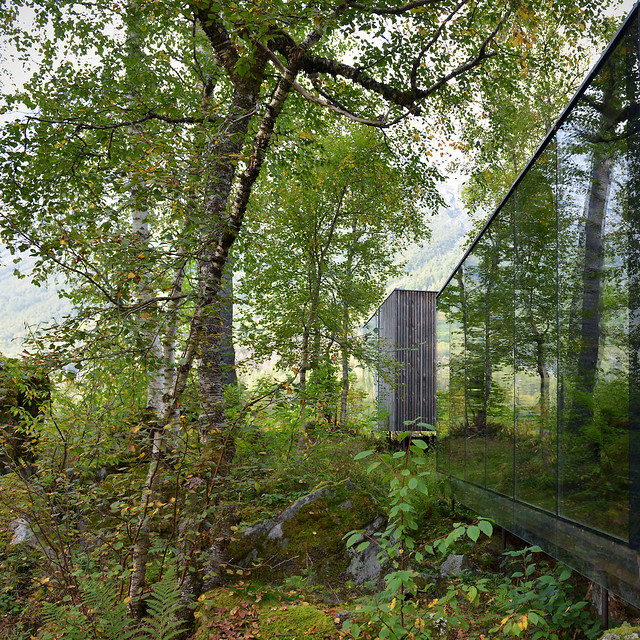
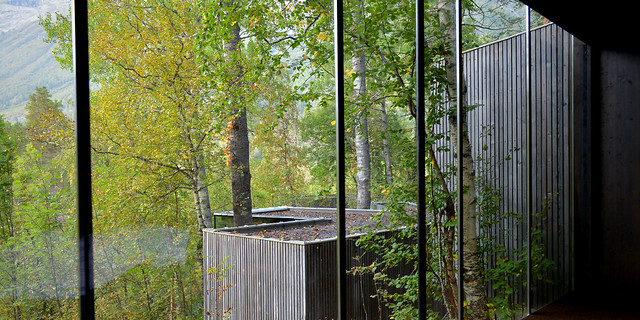
To contribute your Flickr images for consideration, just:
To contribute your Flickr images for consideration, just:
:: Join and add photos to the archidose poolTo contribute your Instagram images for consideration, just:
:: Tag your photos #archidose
Saturday, September 20, 2014
Untitled Landscapes
 [Image: Untitled (Uranium tailings); Mexican Hat, UT, 2005, by Victoria Sambunaris, from Taxonomy of a Landscape].
Design writer Sarah Rich has posted some really spectacular images by photographer Victoria Sambunaris, along with a short Q&A discussing landscapes altered by human activities and industry.
Truck yards butt up against uranium disposal cells and open pit mines yawn over the horizon from border fences that stretch like continuous monuments through the desert.
 [Image: Untitled (talc mine benches); Cameron, MT, 2009, by Victoria Sambunaris, from Taxonomy of a Landscape].
Sambunaris is, in Rich's words, "a 21st-century documentarian of human presence in the American landscape... a kind of mapmaker, displaying the layers of material and the layout of space that compose a particular geographic region."
 [Image: Untitled (Houses); Wendover, UT, 2007, by Victoria Sambunaris, from Taxonomy of a Landscape].
These layers include infrastructure and housing, but also—and, in some ways, more interestingly—the subtle traces of invisible legislative superstructures that come to define the scenes in question.
For example, Sambunaris's shot of Yellowstone National Park—which you can see in the original interview—betrays human meddling on a different scale altogether, precisely through its absence of any visible interference. That is, the landscape depicted in Sambunaris's photo has, in fact, been artificially scrubbed clean of all human traces by an unseen scaffolding of political regulation—its declaration and protection as a National Park—making even this a kind of altered landscape, an arranged scenography planned and implemented from afar by human beings.
In any case, click through to read the full interview, but also consider picking up a copy of the photographer's new book, Taxonomy of a Landscape, with an accompanying essay by Natasha Egan.
Friday, September 19, 2014
Empty Landscapes of Invisible Dangers
 [Image: "The Polygon Nuclear Test Site 1 (After the Event)," Kazakhstan (2011); photo by Nadav Kander/©Nadav Kander, courtesy of Flowers Gallery].
The new book Dust by Nadav Kander documents the broken test-cities of the Soviet nuclear program, with shells of partially dismantled buildings lying scattered across the landscape like dead monuments, anonymous and unsigned.
 [Image: "The Polygon Nuclear Test Site VII," Kazakhstan (2011); photo by Nadav Kander/©Nadav Kander, courtesy of Flowers Gallery].
As the Guardian describes Kander's work—which opened just last week at London's Flowers Gallery—the "desolate is rendered sublime—almost too perfect—in these epic images of a land laid waste by Soviet nuclear ambitions."
What you're looking at are, in the gallery's words, "the radioactive ruins of secret cities on the border between Kazakhstan and Russia," architectural targets now collapsing wall by wall into the barren plain.
 [Image: "Priozersk (Military Housing)" Kazakhstan (2011); photo by Nadav Kander/©Nadav Kander, courtesy of Flowers Gallery].
The region they're in was known simply as the "Polygon," a suitably abstract designation for what was essentially a nuclear sacrifice zone. From the gallery:
Priozersk (formally known as "Moscow 10") and Kurchatov are closed cities, restricted military zones, concealed and not shown on maps until they were "discovered" by Google Earth. Enlisted to the pursuits of science and war, the sites were utilized for the covert testing of atomic and long distance weapons. Falsely claimed as uninhabited, the cities, along with nearby testing site "The Polygon" set the stage for one of the most cynical experiments ever undertaken. Scientists watched and silently documented the horrifying effects of radiation and pollution on the local population and livestock.Kander's photos are on display until October 11, but you can also buy the book from publisher Hatje Cantz.
 [Image: "The Aral Sea I (Officers Housing)," Kazakhstan (2011); photo by Nadav Kander/©Nadav Kander, courtesy of Flowers Gallery].
In the meantime, be sure to check out the gallery's website for many more photos, and the artist's own portfolio includes other series well worth a look, such as photos from the Arctic Circle, from the ruins of Chernobyl, and even a fantastic, David Lynchian project called "Night," featuring all but depopulated suburban landscapes lit up by street lamps and garages.
(Note: This post's title—"empty landscapes of invisible dangers"—comes from Nadav Kander, as quoted in the Flowers Gallery press release).
Procedural Forestry
 [Image: A "procedural forest gone wrong... or right?," developed by Florian Veltman].
We looked at procedural Brutalism the other week—and, deep in the BLDGBLOG archives, we explored the moors of a procedurally generated British countryside—so why not procedural forestry?
Designer Florian Veltman tweeted two screen grabs the other week, along with the quick comment that he was "working on a procedural forest." The first image, which you can see in his tweet, is just a path or small clearing—almost a holloway—cutting forward through a forest of algorithmic leaves and branches.
But it's the picturesque errorscape seen in the opening image of this post, and in Veltman's second tweet, that really caught my eye. Captioned by Veltman as a "procedural forest gone wrong... or right?," it resembles a kind of upended tectonic plate overgrown with vegetation, pierced by the alien presence of a miscalculated substrate erupting from below.
Procedural forestry, procedural geology, procedural oceanography—the very idea of a procedural natural history is just incredible. Unstoppable worlds endlessly flowering from roots of code. Imagine landscape information modeling becoming weirdly sentient, self-generating, and aesthetically sublime, laced with errors, topographies gone wild—stuttering and mutated—in the infinite seams between digital worlds.
We watch in unearthly awe as coded terrains crack open or glitch apart just enough to reveal their mathematical interiors, buried operating systems indistinguishable from nature whirring away within the roots and leaves.
(Indirectly spotted via @jimrossignol).
Subscribe to:
Posts (Atom)